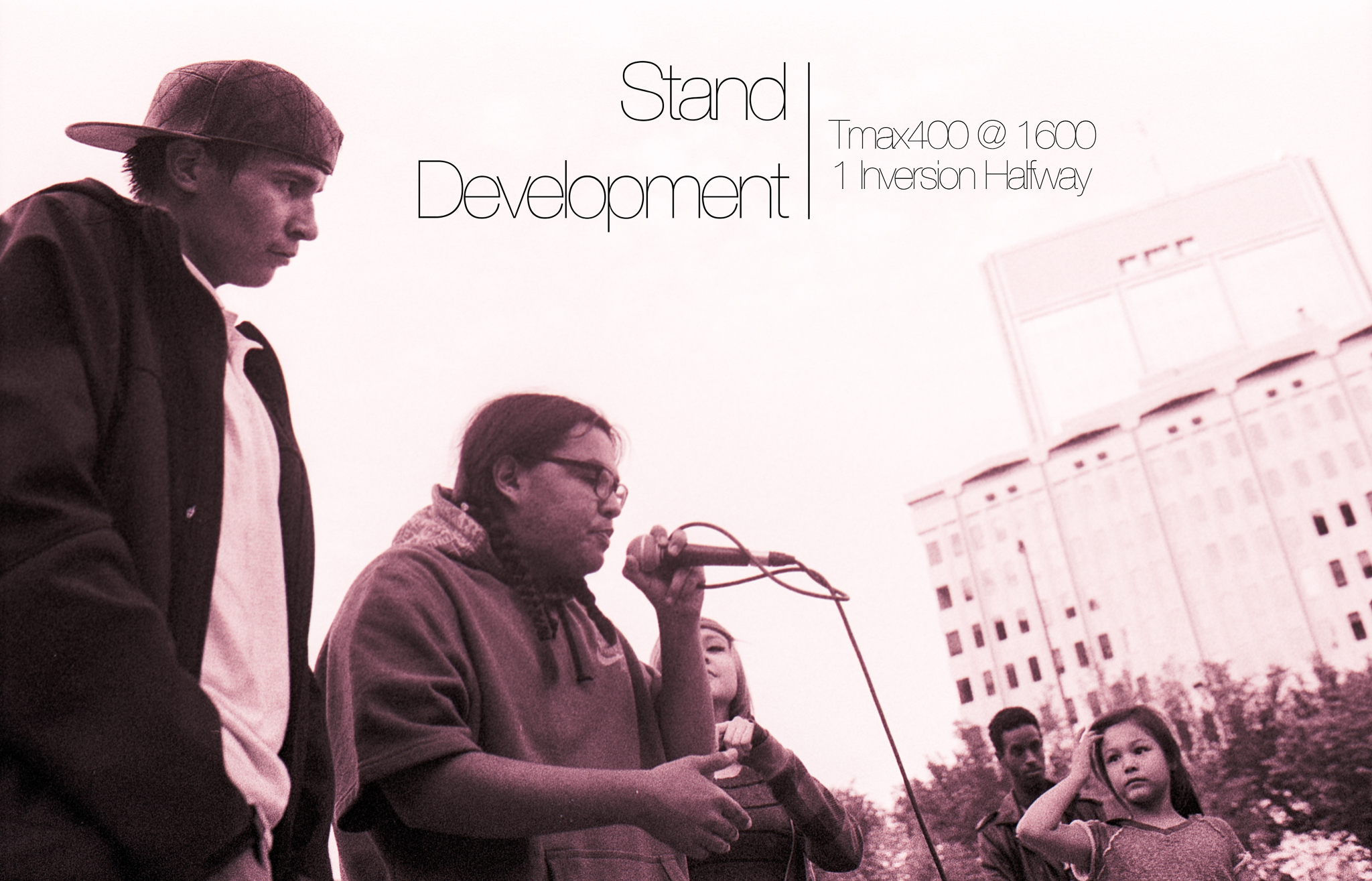
I've had these random black and white rolls of film in my fridge for a little while. I have no idea when I shot them and I don't know if I pushed the ASA. Couple weeks back I remembered reading about stand development a few years back. In a nutshell, you use a highly diluted development formula. You don't make any inversions, or very few at all. You let the film sit in your concoction for a long period of time. Finally, you proceed with your normal stop bath and fixer steps. I won't try to explain how this works, as there are many great ressources out there able to explain it better than I would. But, the results are that you are able to process film of different ISO in the same mixture and get a decent exposure out of these. In my case, I developed a random roll I forgot at which ASA i pushed to (probably 1600). Lets look at the results.

More Cypher Wild goodness! I was pleasantly surprised at the results. As soon As I pulled out the negatives from the development tank, I saw they were nice and thick. The scans revealed nice contrast in the images. I adjusted the contrast here and there in Lightroom, but these are pretty much as-is. One drawback I remember reading about was the gradient effect in exposure. Since I did a semi stand process (inverting once at the half way mark) this is mitigated. Another way of preventing this effect, which seems to be highly recommended by some versus the semi stand, is to pay close attention to the temperature. Since the temperature drops over the long development time, the exposure is affected.
Stand development is promises great results for pushing film, yet retaining small grain structure and high contrast. These are all features I like in my B&W. I got a little exited yesterday and tried to push a roll of delta 100 to 1600. It failed miserably and was completely under-exposed. I will definitively be experimenting further with this process and see how far I can go while still retaining acceptable results. Here are a few informative links that proved very helpful to me so far.
Ted Forbe's Art Of Photography youtube series is a great introduction to anyone who wishes to delve into analog photography. Lots of information about cameras, film, famous photographers, etc....
This blog post was my initial introduction to the stand development a few years back. A great read.
For anything else, there's always APUG.
One of the largest public forum about film photography. Ask and discuss with veterans of the medium.